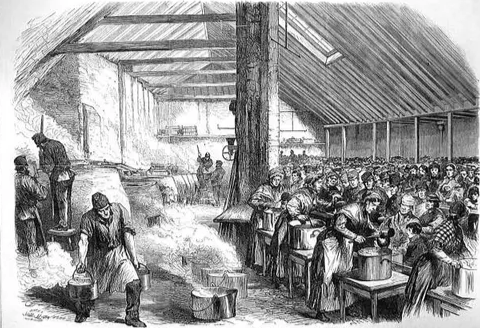
The Blackburn Soup Kitchen
Up until 1861 Blackburn in Lancashire was a thriving cotton town. Whole families worked in the mills and during the prosperous years of the cotton trade, it was not unusual for a family to be earning £5 or £6 a week. People weren’t rich, but they were living comfortably.
When the flow of raw cotton dried up because of the American Civil War, those families lost jobs and income.
According to the census of 1861, the population of Blackburn was 63,126. Out of this number, about 25,000 were employed in various branches of the cotton manufacturing. If you take into account young children and non-workers, then it was estimated by William Gourlay in his book History of the Distress in Blackburn 1861-5, that 79% of the entire population of the town were dependent on one industry. And when you add employees of the various engineering works about the town that provided the mills with machinery, then you increase the number to 89% of the population threatened with starvation to say nothing of shopkeepers, many of whom were ruined, or like my great, great grandfather, lost a substantial amount of money.
As the winter of 1861 approached, more and more people were applying to the Poor Law Guardians for relief. But a notion prevailed amongst the working classes of the town, that it was shameful to accept relief from the Guardians and often pride prevented them coming forwards. So the mayor, Robert Hopwood Hutchinson, and alderman of the town, along with W.H. Hornby M.P. and James Pilkington M.P. met in the mayor’s parlour on 18th November to discuss what could be done. A resolution was passed for establishing some institution where provisions should be periodically distributed for the necessities of the distressed. So was born the idea for a soup kitchen.
Premises were found on Cleaver Street and put at the disposal of the soup kitchen committee by Messrs. Yates. Alderman Boyle and Mr James Eastwood lent the committee copper boilers in which to make the soup and on Wednesday 22nd January, the first distribution took place.
There were 640 quarts of soup. Tickets were distributed for 560 quarts and the rest was sold at a penny a quart. The composition of the soup is recorded as: beef, 120lbs; barley, 60lbs; groats, 20lbs; peas, 60lbs; onions, 18lbs; carrots, 20lbs; turnips, 10lbs; salt, 10lbs; cayenne pepper ¾ ounce; white pepper, 3ozs. The cost was five (old) pence a gallon.
By the end of 1862, there were more than 30,000 recipients of help from the Poor Law Guardians. 1200 quarts of soup and one and a half tons of bread were distributed each day at a cost of £1500 a week. Most of this money was raised by donations and public subscriptions from wealthy and not so wealthy donors. Mr Charles Tiplady wrote a letter to The Times detailing the extent of the distress, which resulted in contributions amounting to £237. The book contains various lists of subscriptions received from thousands of pounds from The Lord Mayor’s Fund to two pounds from the Rev. J. Hewitt. Well know Blackburn names appear, including the Hornbys, the Fieldens, and further afield from the Archbishop of Canterbury, Mrs William Gladstone and the Earl of Derby. In the days before the welfare state, the survival of the cotton workers depended on goodwill and generosity from the wealthy, many of whom came to visit the town to see for themselves the extent of the distress.
The distribution of soup continued until May 1863.

